
News & Insights
Insights

Insights

Insights
July 1, 2026
Cybersecurity: Securing the AI Economy
Insights
July 1, 2026
The Leaders in Online Betting
Insights
June 23, 2026
Semiconductors - The Oil of the 21st Century
1
2
3
Insights
June 23, 2026


Semiconductors - The Oil of the 21st Century
Artificial intelligence is one of the greatest technological shifts since the emergence of the Internet. Behind every AI model, every data centre and every autonomous system lies a critical infrastructure: semiconductors.
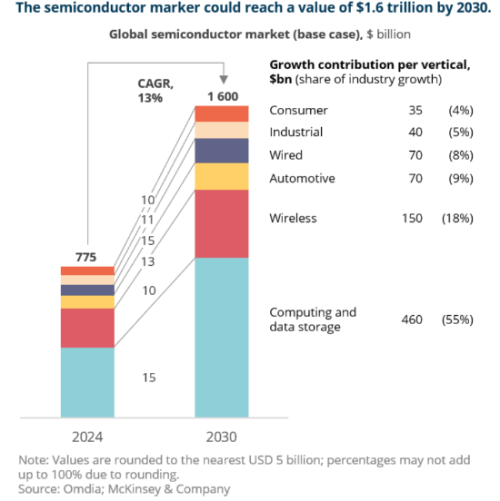
Our investment thesis is based on the idea that electronic chips now hold a strategic position in the global economy. As artificial intelligence, automation and digital infrastructure continue to expand, demand for computing power should continue to provide lasting support for the semiconductor sector.
NEW INFRASTRUCTURE: THE RISE OF AI AND ADVANCED COMPUTING
Spending related to artificial intelligence is rising sharply. Leading technology players are investing heavily in computing infrastructure to meet growing demand, particularly in data centres.
At the same time, the emergence of physical AI, including robotics, autonomous vehicles, drones and industrial automation, is opening up a new growth cycle for semiconductors. These applications require increasingly powerful chips, not only for training AI models, but also for deploying them across the real economy.
Technological sovereignty is also an important driver. Governments and companies are seeking to secure their supply chains and develop strategic industrial capabilities, further strengthening the central role of key players across the semiconductor value chain.
KEY GROWTH DRIVERS
Several structural trends are supporting demand for semiconductors:
• Generative AI, which is driving a significant increase in computing requirements;
• Data centres, which require substantial investment in technological infrastructure;
• Robotics and industrial automation, which are boosting demand for embedded chips;
• Technological sovereignty, which is encouraging the development of strategic industrial capabilities.
These growth drivers benefit the three selected companies, either directly or indirectly. ASML is exposed to demand for advanced semiconductor manufacturing equipment, TSMC to chip production itself, and NVIDIA to the end use of computing power in artificial intelligence.
BENEFICIARIES
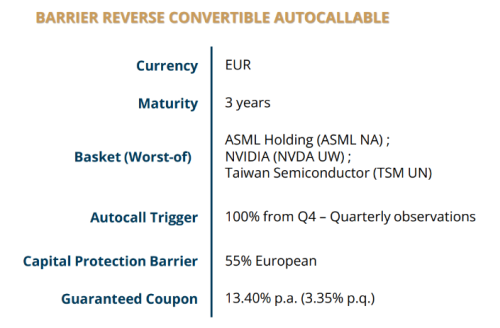
- ASML Holding (ASML NA)
- NVIDIA (NVDA UW)
- Taiwan Semiconductor Manufacturing (TSMC UN)
More information available in the Full Trade Idea
Product Snapshot | BRC Autocallable
For informational purposes only. Not investment advice.
Insights
June 23, 2026
Semiconductors - The Oil of the 21st Century
Artificial intelligence is one of the greatest technological shifts since the emergence of the Internet. Behind every AI model, every data centre and every autonomous system lies a critical infrastructure: semiconductors.
Our investment thesis is based on the idea that electronic chips now hold a strategic position in the global economy. As artificial intelligence, automation and digital infrastructure continue to expand, demand for computing power should continue to provide lasting support for the semiconductor sector.
NEW INFRASTRUCTURE: THE RISE OF AI AND ADVANCED COMPUTING
Spending related to artificial intelligence is rising sharply. Leading technology players are investing heavily in computing infrastructure to meet growing demand, particularly in data centres.
At the same time, the emergence of physical AI, including robotics, autonomous vehicles, drones and industrial automation, is opening up a new growth cycle for semiconductors. These applications require increasingly powerful chips, not only for training AI models, but also for deploying them across the real economy.
Technological sovereignty is also an important driver. Governments and companies are seeking to secure their supply chains and develop strategic industrial capabilities, further strengthening the central role of key players across the semiconductor value chain.
KEY GROWTH DRIVERS
Several structural trends are supporting demand for semiconductors:
• Generative AI, which is driving a significant increase in computing requirements;
• Data centres, which require substantial investment in technological infrastructure;
• Robotics and industrial automation, which are boosting demand for embedded chips;
• Technological sovereignty, which is encouraging the development of strategic industrial capabilities.
These growth drivers benefit the three selected companies, either directly or indirectly. ASML is exposed to demand for advanced semiconductor manufacturing equipment, TSMC to chip production itself, and NVIDIA to the end use of computing power in artificial intelligence.
BENEFICIARIES
- ASML Holding (ASML NA)
- NVIDIA (NVDA UW)
- Taiwan Semiconductor Manufacturing (TSMC UN)
More information available in the Full Trade Idea
Product Snapshot | BRC Autocallable
For informational purposes only. Not investment advice.